
AI Just Killed Online Courses! No, But Bad Courses Are
The short answer is no. Online courses are not dead because of AI.
What is dying is the old version of the online course business: long video libraries that repackage information learners can now get in seconds from ChatGPT, Claude, Gemini, or a search engine with AI answers.
AI did not remove the demand for learning. It changed the standard. If your course only sells access to information, it is weaker than it used to be. If your course helps people apply knowledge, get results faster, and stay accountable, demand is still very real.
That distinction matters.
It is also not the first time people have predicted the end of online courses.
Around 2016, many creators were already saying online courses were dead because YouTube had made educational content free and unlimited. The logic sounded familiar: why would anyone pay for a course when they could watch tutorials for free?
But YouTube did not kill online courses. It killed some weak ones.
The courses that survived were the ones that offered more than access to information. They gave learners structure, depth, community, accountability, and a faster path to a real outcome.
AI is creating a similar shift now, just faster and more aggressively. The pattern is not new. The tools changed, but the market response is similar: generic information gets commoditized, while clear transformation keeps its value.
Why people think online courses are dead
There are good reasons the question keeps coming up.
1. AI makes generic information cheap
If someone wants a basic explanation of marketing funnels, Python loops, prompt engineering, or course design, they can ask an AI tool and get a decent answer immediately.
That makes low-depth educational products much harder to sell. A course that just repeats public knowledge without structure or depth now feels overpriced.
2. Learners expect faster outcomes
People are less willing to spend eight hours watching lessons before doing anything useful. AI has trained users to expect speed, iteration, and direct answers.
Courses that feel slow, bloated, or passive lose attention quickly.
3. Many course libraries were already weak products
Even before AI, plenty of online courses had the same problem: too much content, not enough transformation.
They promised outcomes, but mostly delivered recordings.
AI exposed that weakness. If the core value of a course is "I organized some information into modules," that is no longer enough.
What AI cannot replace easily
AI is strong at generating explanations. It is weaker at replacing a well-designed learning experience.
The courses that still work tend to offer one or more of these things.
Structured progression
Learners usually do not fail because information is unavailable. They fail because they do not know what to do first, what matters most, or what to ignore.
A strong course reduces noise. It gives people a path.
That path is still valuable, especially for beginners and teams that need consistency.
Context and judgment
AI can suggest a hundred tactics. It cannot always tell a learner which tactic fits their exact stage, business model, industry, or constraints.
Expert-created courses become more valuable when they explain trade-offs, sequencing, and real-world decision-making.
Accountability
This is one of the biggest gaps in AI-first learning.
People often know what to do. They still do not finish. Courses that include milestones, assignments, checklists, office hours, community, or manager-led implementation are solving a real problem that AI alone does not solve.
Credibility and proof
Anyone can ask AI how to do something. Not everyone can trust the answer.
Courses built from direct experience, tested systems, and clear case studies still stand out because learners want to reduce risk. They are not only buying information. They are buying confidence that the path has worked before.
The old course model is what is failing
If you sell courses, the problem is not "AI killed education."
The problem is that AI destroyed the premium on undifferentiated information.
That means these course types are getting squeezed:
- Generic beginner courses with no point of view
- Video libraries with little practical implementation
- Courses that could be replaced by a good prompt and 20 minutes of follow-up questions
- Expensive products that promise outcomes but only ship content
In other words, AI is killing weak packaging, not real learning products.
What still makes an online course valuable in 2026
If you are creating or selling a course now, you need to be much clearer about where the value lives.
The strongest courses usually win on one of these dimensions.
1. Speed to outcome
Can your course help someone get a useful result faster than figuring it out alone with AI?
That might mean templates, step-by-step workflows, curated tools, implementation examples, or a clearer path than a learner could assemble on their own.
2. Specificity
Broad courses are easier for AI to compete with. Narrow courses are harder.
"How to market anything" is weak.
"How a fitness coach with fewer than 5,000 followers can launch a paid video course in 14 days" is stronger.
Specificity creates relevance, and relevance increases perceived value.
3. Support and feedback
The more your product helps learners apply the material, the safer it becomes from AI substitution.
Feedback loops matter. Reviews, comments, live sessions, implementation guidance, peer discussion, and progress tracking all make the product more useful.
4. Proprietary insight
If your course is based on original systems, internal processes, accumulated client work, or lessons from repeated execution, AI cannot easily copy that value.
The more your course reflects lived expertise instead of public summaries, the stronger it becomes.
A better question: what are learners buying now?
In 2026, most learners are not buying raw knowledge.
They are buying:
- A curated path
- Reduced trial and error
- A system they trust
- Accountability to finish
- Proof that the outcome is achievable
- A smoother implementation experience
That is why online courses still work when they are designed like products instead of content dumps.
How course creators should adapt
If you already have a course business, you do not need to panic. But you do need to reposition.
Here are the practical shifts that matter most.
Design for implementation, not consumption
Do not ask, "What lessons should I record?"
Ask, "What actions should the learner complete by the end of each module?"
That small shift usually improves the whole product.
Use AI inside the course experience
AI is not only competition. It can be part of the solution.
You can teach learners how to use AI well in your domain, provide prompts, show decision frameworks, and turn AI into a tool that supports the method you teach.
The best creators are not pretending AI does not exist. They are integrating it.
Make the offer narrower and clearer
Generic positioning is harder than ever.
A clear audience, a clear problem, and a clear outcome will outperform a broad promise almost every time.
Add proof and examples
Show real outputs, real learner wins, real case studies, and real implementation details.
This builds trust and separates your material from generated answers that sound plausible but have no evidence behind them.
Own your distribution
If courses are becoming more competitive, owning your audience and brand matters even more.
Publishing your course on your own site gives you more control over SEO, positioning, design, and the full learner journey.
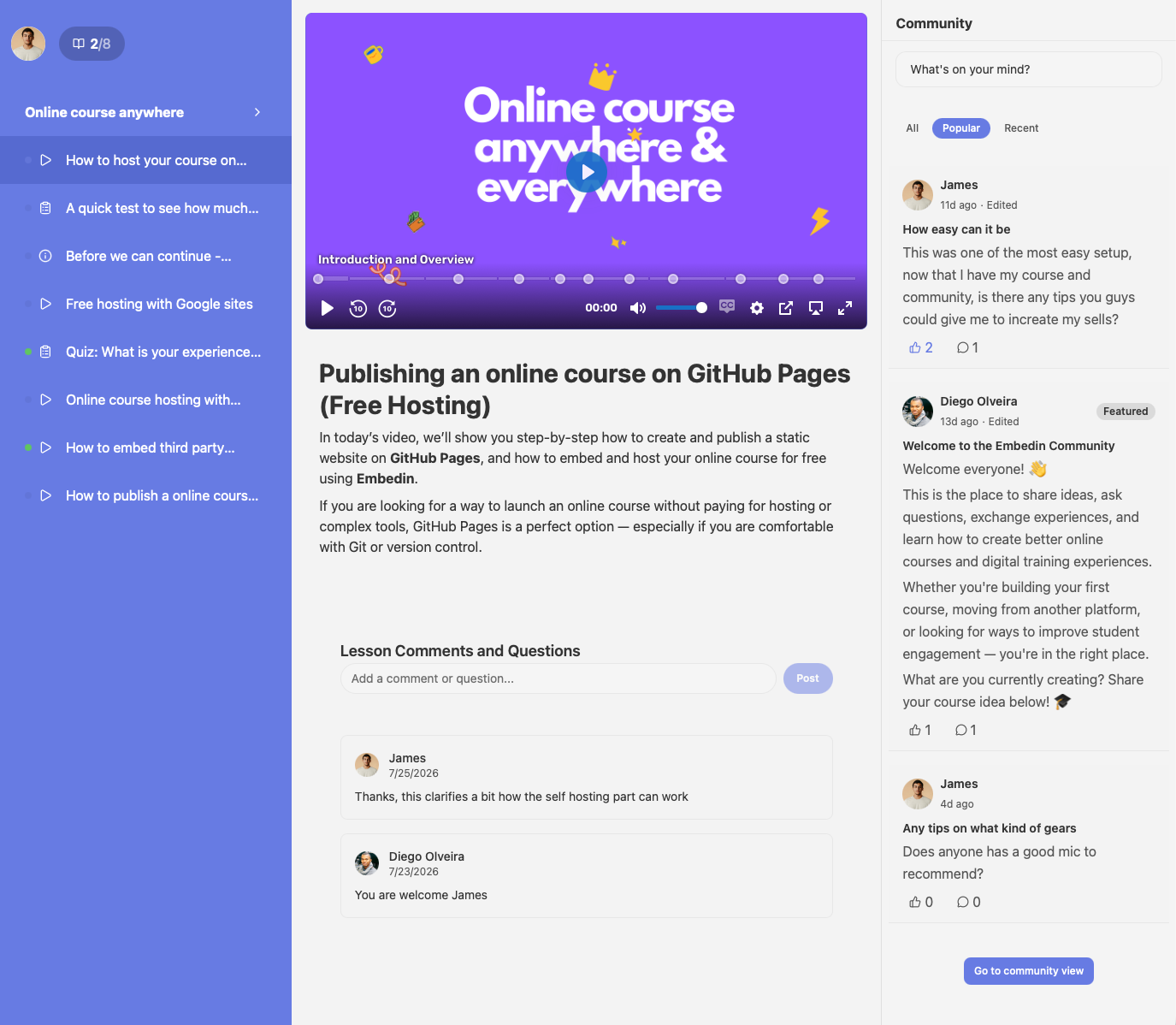
That is one reason embeddable course platforms are gaining attention. They let creators and businesses keep the course experience inside the website they already control, instead of pushing everything into a third-party marketplace.
So, is online course dead with AI?
No.
But lazy course creation is.
The easy-money phase of selling information products is weaker than before. That is probably a good thing. It pushes creators to build better products: more practical, more specific, more credible, and more outcome-focused.
If your course helps people do something meaningful faster and with less confusion, there is still a market.
If it only gives them information they can already get from AI, the market will keep shrinking.
If you want to publish a course on your own website and keep full control over the learner experience, Embedin gives you a practical way to do that.
.png)