
Best Online Course Platform in 2026
The best online course platform depends less on hype and more on your delivery model. A solo creator selling cohort-based lessons needs different tooling than a company training employees or a business embedding courses inside its own website.
If you are comparing platforms in 2026, the useful question is not "which platform has the most features?" It is "which platform helps me publish faster, own my audience, and keep the learning experience clean?"
In this guide, we break down what actually matters when choosing an online course platform and which type of platform fits different use cases.
What makes an online course platform good?
The strongest platforms usually get six things right:
1. Easy course creation
You should be able to organize lessons, modules, video, text, downloads, and quizzes without fighting the editor. If publishing a lesson feels like managing a spreadsheet, the platform will slow you down.
2. Reliable video delivery
Video is usually the heaviest part of an online course. A good platform should handle hosting, streaming, thumbnails, and playback without forcing you to wire several tools together.
3. Enrollment and access control
At minimum, you need a clean way to enroll users and restrict access to paid or private content. If you plan to sell courses, payments and gated access need to work without manual admin overhead.
4. Branding and ownership
Many platforms make your business feel like a tenant inside their marketplace. If your goal is to build your own brand, your platform should let you use your own domain, your own website, and your own design.
5. Analytics and learner progress
You need visibility into enrollments, lesson completion, and course engagement. Without this, you cannot improve the course or understand where learners drop off.
6. Low operational complexity
The best platform is often the one that removes work. You should not need a custom backend, a separate video pipeline, and three automation tools just to publish a course.
The main types of online course platforms
Most options fall into one of these categories.
All-in-one course platforms
These tools bundle hosting, course pages, checkout, email, and student access in one product.
They work well if you want the fastest route to launch and do not mind working inside the platform's design and product constraints.
Best for:
- First-time course creators
- Small teams
- People who want speed over flexibility
Trade-offs:
- Limited control over design and user experience
- Harder to integrate with your existing website
- Branding may feel platform-first instead of creator-first
Website builders with embedded course delivery
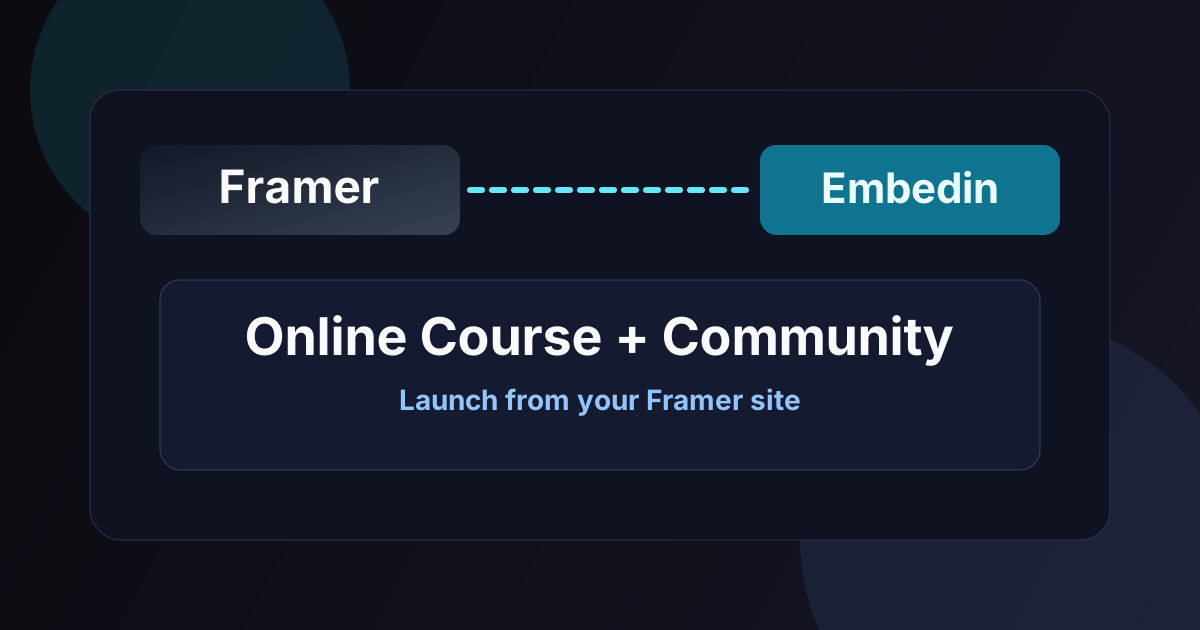
This model is increasingly attractive because it gives you more control. You keep your marketing site in tools like Webflow, Notion, Wix, Squarespace, GitHub Pages, or a custom site, and use a course platform only for the learning experience.
Best for:
- Creators who already have a website
- Businesses that want courses inside their own brand
- Teams that care about SEO, design, and ownership
Trade-offs:
- You need a platform that supports embedding well
- Setup quality depends on how clean the integration is
Internal training and customer education platforms
These platforms are less focused on selling public courses and more focused on onboarding, compliance, partner training, or support education.
Best for:
- Companies training employees
- SaaS teams building customer academies
- Agencies creating private learning hubs
Trade-offs:
- May be heavier than needed for solo creators
- Public marketing and course sales tools can be weaker
What to look for before you choose
Before picking a platform, ask these questions:
- Do you want your course on your own website or on a hosted platform page?
- Do you need private access, paid access, or both?
- Is video your main content format?
- Do you want quizzes, downloads, and learner progress tracking?
- Do you need a simple no-code setup or more flexibility?
- Do you want to own the customer experience end to end?
Your answers narrow the field very quickly.
When an embedded course platform is the better choice
For many creators and businesses, the best setup is not a giant all-in-one platform. It is a focused course delivery platform that can be embedded into the site you already control.
That approach gives you:
- Your own brand and domain
- Freedom to use your preferred website builder
- A cleaner learner experience
- Less platform lock-in
- More flexibility for marketing and SEO
This is especially useful if you already use Notion, Webflow, Wix, Squarespace, or a custom website and do not want to rebuild everything inside a course marketplace.
Why Embedin fits this model well
Embedin is a strong option if your goal is to publish courses inside your own website rather than move your business into another platform's ecosystem.
It is designed for creators and teams who want to:
- Create structured courses with modules and lessons
- Host and stream course video
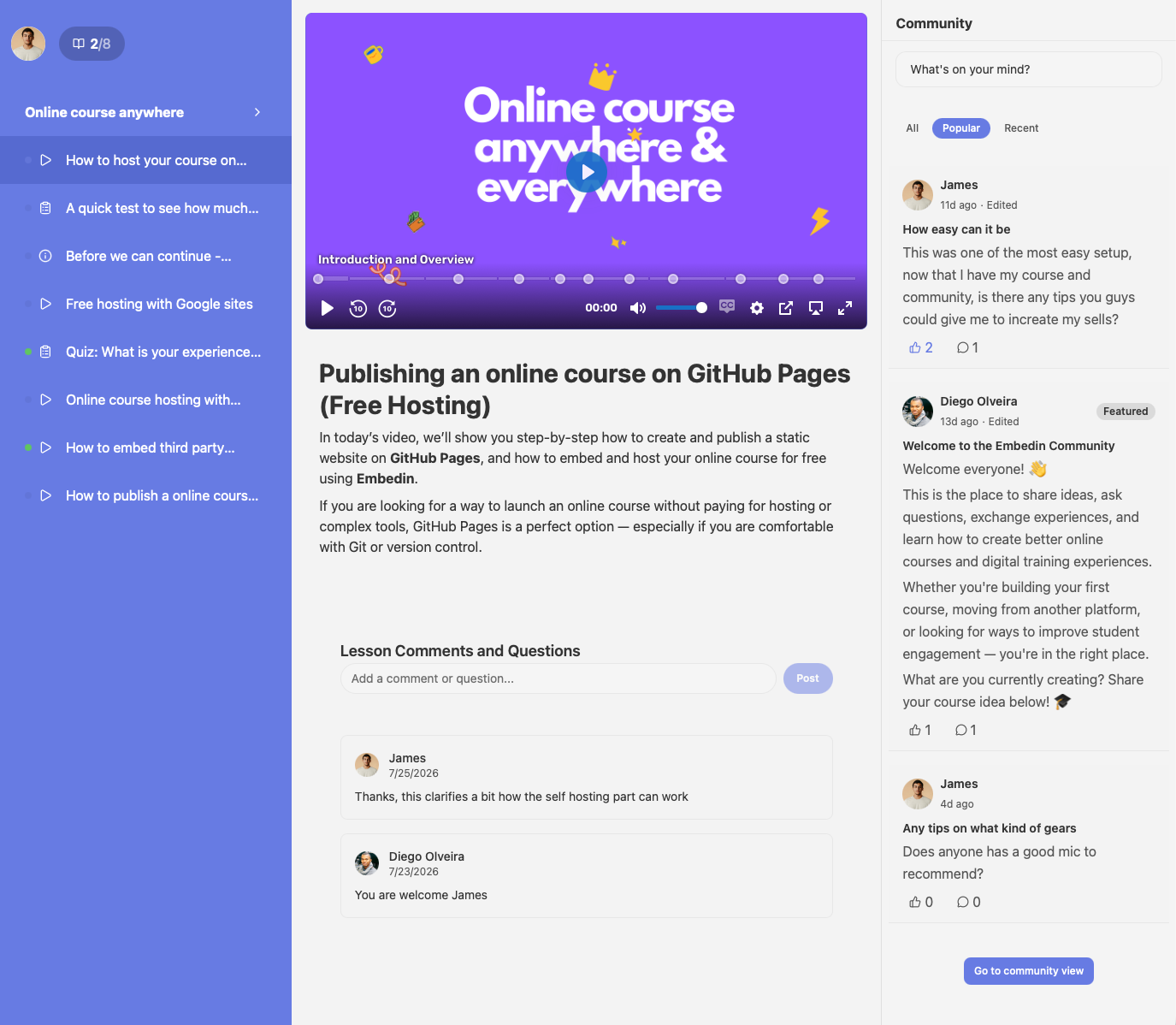
- Embed the learning experience into their own site
- Manage enrollments and gated access
- Keep the course experience aligned with their brand
Instead of forcing you to choose between no-code publishing and ownership, Embedin sits in the middle: simple enough to launch quickly, but flexible enough to work with the website stack you already use.
So, what is the best online course platform?
If you want the shortest path to launch and are comfortable living inside a platform's ecosystem, an all-in-one course platform may be enough.
If you care about brand control, embedding, and owning the full customer journey, the better choice is usually a platform that lets you deliver courses on your own website.
That is where tools like Embedin stand out.
The best online course platform in 2026 is the one that matches your workflow, not the one with the longest feature list.
Final recommendation
Choose based on the experience you want learners to have:
- If you want speed, choose a hosted all-in-one tool.
- If you want ownership, choose an embeddable course platform.
- If you want internal enablement, choose a platform built for private training workflows.
If your goal is to publish courses on your own website without building the infrastructure yourself, create your course with Embedin.
.png)