

How to Keep Students Engaged in Online Courses
Keeping students engaged in online courses is not mainly a content problem. It is a design problem.
Most learners do not drop off because the topic is unimportant. They drop off because the course feels too passive, too long, too vague, or too easy to postpone.
That is the core challenge of online learning. Without the energy of a physical classroom, engagement has to be built into the experience on purpose.
The good news is that engaged students usually respond to the same fundamentals: clear progress, small wins, interaction, relevance, and accountability.
If you want learners to finish your course and get real outcomes, here is what actually works.
Why students disengage in online courses
Before fixing engagement, it helps to understand what causes it to break.
Common reasons include:
- Lessons are too long and hard to fit into a normal day
- The learner does not feel progress quickly enough
- Content is informative but not actionable
- There is no accountability to continue
- The course feels isolating
- The outcome is unclear or too far away
In other words, people disengage when the course asks for too much attention before delivering enough momentum.
That is why the best online courses are not just well explained. They are well paced.
1. Start with a clear outcome
Engagement improves when students know exactly what they are working toward.
If your course promises a broad transformation like "become better at marketing" or "learn design," motivation fades fast. The learner cannot easily tell whether they are making progress.
Stronger course outcomes are specific and visible.
For example:
- Build your first onboarding flow in seven days
- Launch a paid video course on your own website
- Set up a customer education hub for your SaaS team
Specific outcomes create direction. Direction creates commitment.
Each module should also support that promise clearly. If a lesson does not help the learner reach the stated result, it is probably reducing engagement rather than increasing it.
2. Break the course into smaller wins
One of the fastest ways to lose student attention is to make progress feel distant.
People stay engaged when they can complete something meaningful quickly. That means your course should be structured around milestones, not just information delivery.
Instead of this:
- Module 1: Theory
- Module 2: Framework
- Module 3: Tools
- Module 4: Examples
Use something closer to this:
- Module 1: Define the goal
- Module 2: Create the first draft
- Module 3: Publish the first version
- Module 4: Improve based on feedback
The second structure gives students a sense of movement. They are not just consuming lessons. They are getting somewhere.
That difference matters a lot in online learning.
3. Keep lessons short and focused
Long recordings often feel productive to the course creator and exhausting to the learner.
Shorter lessons usually perform better because they reduce friction. A learner is much more likely to start a seven-minute lesson than a 42-minute one.
As a general rule, each lesson should do one job:
- explain one idea
- show one example
- guide one action
This does not mean every lesson must be extremely short. It means every lesson should feel scoped, intentional, and easy to complete.
When students can say, "I can finish this now," engagement goes up.
4. Turn passive content into active learning
Watching is not the same as learning.
Students stay engaged longer when they are asked to do something with the material. That can be simple, but it has to be real.
Good engagement mechanisms include:
- reflection prompts at the end of a lesson
- mini assignments after each module
- templates the learner fills in while watching
- short quizzes that check understanding
- action checklists tied to a concrete task
The goal is not to make the course feel academic. The goal is to keep the learner mentally involved.
The more often students apply what they just learned, the less likely they are to drift.
5. Design for momentum, not perfection
Many online courses accidentally create pressure that slows learners down.
If every module feels large, polished, and demanding, students start waiting for the perfect time to continue. Usually that perfect time never comes.
A better approach is to design for forward motion.
That means:
- giving learners a simple next step
- removing unnecessary setup work
- providing starter templates instead of blank pages
- encouraging rough first versions before refinement
Momentum is one of the most underrated drivers of engagement. Students who move are students who stay.
6. Add accountability where it matters
Information alone rarely keeps people consistent.
Even motivated learners benefit from some form of accountability. This does not have to mean live cohorts or high-touch coaching, though those can help.
Effective accountability can also come from lighter systems such as:
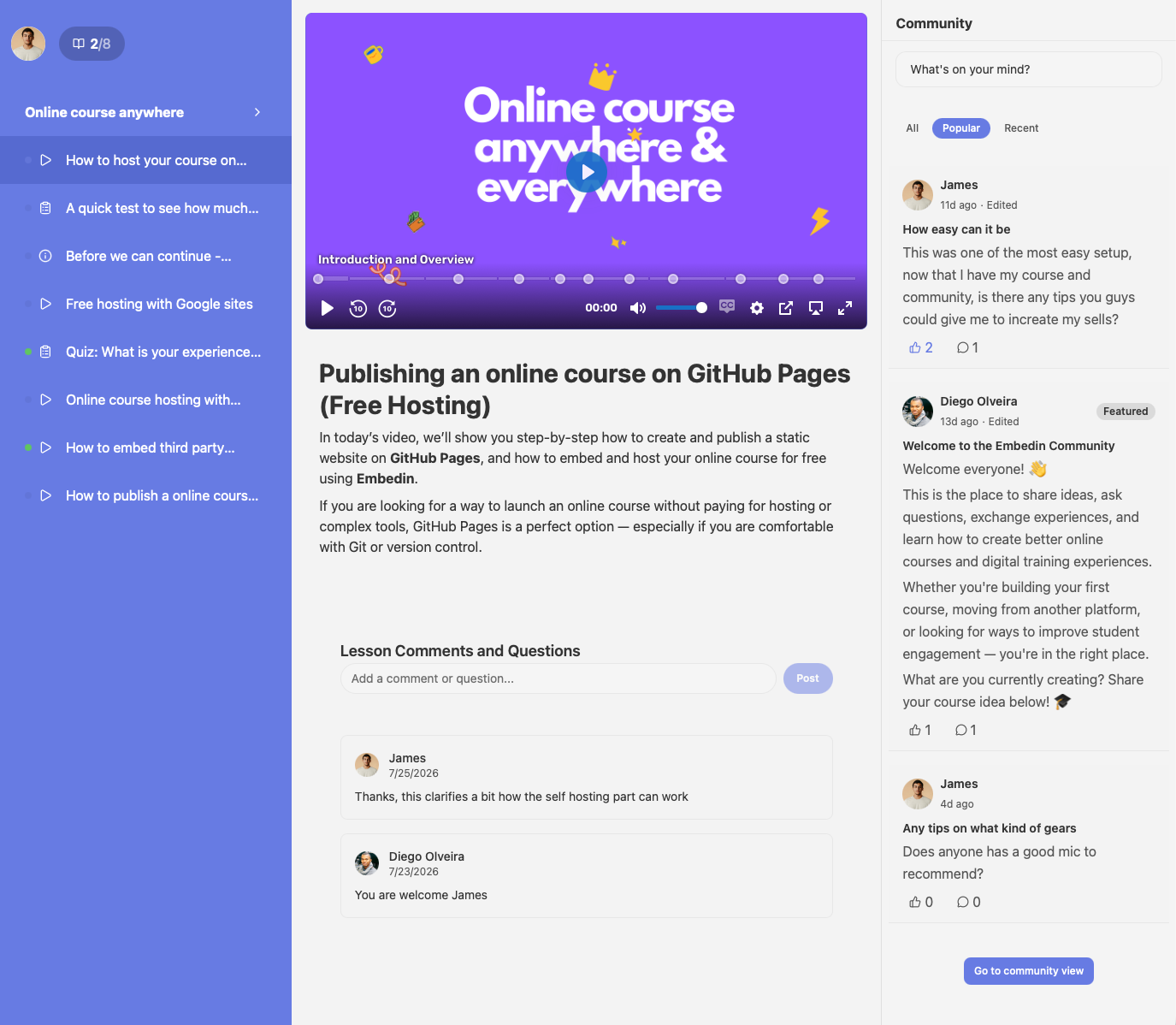
- progress tracking across lessons and modules
- weekly milestone emails
- deadlines for assignments
- peer discussion spaces
- manager check-ins for internal training
The important thing is that the learner feels the course expects progress, not just access.
This is especially important for business training, customer education, and professional development courses where completion actually matters.
7. Make the course feel relevant immediately
Engagement drops when learners cannot connect the material to their real situation.
That is why examples matter. Screenshots matter. Use cases matter. Case studies matter.
Students are more likely to stay when they can see how the lesson applies to their work, project, role, or goal.
You can improve this by:
- using examples from the learner's context
- showing before-and-after outcomes
- including realistic scenarios instead of abstract theory
- letting learners choose a path based on their use case
Relevance keeps attention because it reduces the mental gap between the lesson and the learner's world.
8. Reduce isolation
One reason online learning can feel hard is that it is easy to disappear quietly.
When students feel alone, small obstacles become stopping points. A question goes unanswered, momentum drops, and the course starts feeling abandoned.
You do not need a huge community to reduce isolation. Even small touchpoints help:
- comments or discussion threads under lessons
- office hours or optional live Q and A sessions
- feedback on assignments
- learner showcases or progress updates
These features make the course feel alive. That alone can improve completion.
9. Show progress clearly
Visible progress is motivating.
When students can see what they have completed and what is left, the course feels more manageable. When they cannot, it feels endless.
Simple progress indicators often make a real difference:
- lesson completion states
- module progress bars
- milestone checkpoints
- certificates or completion markers for key stages
Progress design is not cosmetic. It changes how effort feels.
People are more likely to continue when they can see evidence that their work is adding up.
10. Improve pacing using real learner behavior
You do not have to guess where engagement is breaking. In many cases, your course data will show you.
Look for patterns such as:
- lessons with unusual drop-off
- modules with low completion rates
- assignments that students skip
- points where support questions spike
These are often signs that something is too long, unclear, difficult, or disconnected from the learner's goals.
Good course creators treat engagement as an iterative design problem. They review where learners stall and adjust the experience.
That may mean splitting a lesson, rewriting instructions, adding an example, or moving an action step earlier.
A simple engagement framework for online courses
If you want a practical way to evaluate a course, use this checklist:
- Is the outcome specific?
- Does the learner get a small win early?
- Are lessons short and focused?
- Is each module tied to a real action?
- Can learners see progress easily?
- Is there any accountability?
- Does the course feel relevant to real-world use cases?
- Can students get help when they are stuck?
If several of these are missing, engagement problems are usually not surprising.
Final thought
The most engaging online courses do not rely on charisma alone. They reduce friction, create momentum, and help students act.
That is the standard to aim for whether you are building a public course, internal training program, or customer education library.
If your course experience lives on your own website, engagement also improves when the learning flow feels native to your brand and easy to access. That is one reason many teams use Embedin to publish courses directly inside their existing site instead of sending learners to a disconnected platform.
The simpler it is for students to start, progress, and return, the easier it is to keep them engaged.
.png)